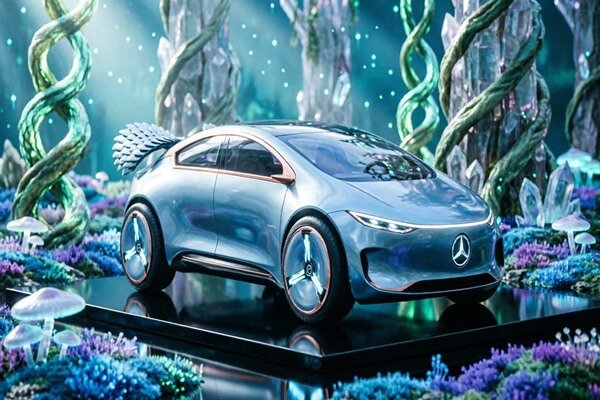
The Mercedes Vision AVTR sits on exhibition floors and instantly grabs attention. It does not look like a regular car. It feels like something alive. This concept vehicle goes beyond design and performance. It challenges how we interact with machines.
Mercedes-Benz worked with James Cameron and the Avatar team to build this concept. The idea was simple but powerful. Create a vehicle that connects humans, technology, and nature. The result is a car without a steering wheel, without pedals, and with the ability to move sideways. It reads your body signals and responds in real time. This is no longer just imagination.
What is Mercedes Vision AVTR?
Mercedes-Benz revealed the Vision AVTR at the Consumer Electronics Show in Las Vegas. The name stands for Advanced Vehicle Transformation and Responsive.
Every part of this vehicle takes inspiration from Pandora, the fictional world from Avatar. The goal was to design a car that feels alive and works in harmony with nature.
This is not a production model. It is a concept that shows how future cars might look and behave.
Design Inspired by Nature
The design of the Vision AVTR flows like water. There are no sharp lines or aggressive edges. Instead, smooth curves dominate the entire body.
The car measures around 4803 mm in length, 1908 mm in width, and 1635 mm in height. These proportions give it a futuristic yet natural presence.
The rear section features 33 movable bionic flaps. These flaps look like reptile scales or fish fins. They adjust automatically based on driving conditions.
These flaps are not just for looks. They help control airflow, improve efficiency, and create a visual connection between the car and nature.
The front grille uses illuminated LED patterns that react to movement. A full-width light bar adds a strong futuristic identity.
Driving Without a Steering Wheel
The most surprising part of the Vision AVTR is the absence of a steering wheel.
Instead, there is a central control unit placed between the seats. The driver places their hand on it to control the vehicle.
The system reads hand movements and translates them into driving actions. Move your hand to turn. Push forward to accelerate. Pull back to slow down.
This creates a direct connection between human intention and machine response.
The system also reads biometric signals like heartbeat and breathing. It adjusts settings based on your comfort level.
Electric Power and Performance
The Vision AVTR is powered by four electric motors, one on each wheel. This setup produces around 469 horsepower.
Acceleration from zero to 100 km/h happens in under five seconds. The top speed is about 250 km/h.
Each motor works independently, allowing precise control of power distribution. This improves stability, traction, and handling.
The car also features torque vectoring, which helps maintain control in different driving conditions.
Also read: Mahindra XUV 800 On Road Price: Complete Guide With Specs And Features
Crab Movement and Spherical Wheels
One of the most unique features is its ability to move sideways.
The spherical wheels can rotate at angles up to 30 degrees. This allows the car to move diagonally, also known as crab movement.
This feature makes parking easier and improves maneuverability in tight spaces.
The wheels themselves are illuminated and designed with a futuristic look. They enhance both functionality and visual appeal.
Graphene-Based Battery Technology
The Vision AVTR uses a 110 kWh graphene-based battery. This is different from traditional lithium-ion batteries.
Graphene offers better energy density, meaning more power with less weight. It is also fully recyclable and does not rely on rare earth metals.
This battery can be charged in less than 15 minutes using advanced conductive charging technology.
The estimated driving range is over 700 kilometers on a full charge.
This technology could change how electric vehicles work in the future.
Interior Experience and Materials
The interior feels more like a living space than a car cabin.
Mercedes uses sustainable materials such as vegan DINAMICA leather and Karuun wood. These materials reduce environmental impact while maintaining luxury.
The seats have organic shapes and appear to float inside the cabin. A full glass roof creates an open and airy feel.
Instead of a traditional dashboard, a curved display runs across the cabin. It shows augmented reality visuals and real-time data.
Passengers can even see invisible elements like energy flow or environmental data.
Gesture and Biometric Controls
The Vision AVTR uses advanced gesture control for most functions.
You can adjust settings by simply moving your hand. No buttons or switches are needed.
The system also tracks biometric signals like heart rate and breathing patterns.
If it detects stress or fatigue, it can adjust lighting, sound, or climate to improve comfort.
Voice control is also included, allowing natural interaction with the system.
Environmental Responsibility
The Vision AVTR produces zero emissions. It runs entirely on electric power.
The use of sustainable materials reduces environmental impact during production.
The graphene battery avoids harmful materials like cobalt, which are commonly used in traditional batteries.
This approach shows that luxury and sustainability can go together.
Mercedes Vision AVTR Price in India
The Mercedes Vision AVTR price in India is expected to be between ₹1.81 crore and ₹2.06 crore if it ever goes into production.
In global markets, the estimated price ranges from $210,000 to $250,000.
This pricing places it in the ultra-luxury segment.
The high cost comes from advanced technology, unique design, and limited production possibilities.
Availability and Launch Status
The Vision AVTR is still a concept car. Mercedes-Benz has not announced any official production plans.
There is no confirmed launch date for India or any other country.
Some features may appear in future Mercedes models, but the full concept is unlikely to be released as it is.
Future Possibilities
Even though the Vision AVTR is not available for sale, its impact is already visible.
Technologies like gesture control and biometric systems are being tested in modern cars.
The graphene battery could become a major breakthrough in electric mobility.
Concept cars like this act as testing platforms for future innovations.
Final Thoughts
The Mercedes Vision AVTR changes how we think about cars. It removes traditional controls and replaces them with intuitive interaction.
It combines performance, sustainability, and futuristic design in a single concept.
The expected Mercedes Vision AVTR price in India reflects its advanced technology and exclusivity.
Even if it never reaches production, its ideas will shape the next generation of vehicles.
This is not just a car. It is a glimpse into the future of mobility.